In this guide
- Quick Safety Warning: What to Do If the Gauge Climbs
- Don't Keep Driving — and Be Careful With Water
- How Your Radiator and Cooling Fans Work
- The Water Pump and Thermostat
- Sensors, Hoses, Pressure, and the Coolant Reservoir
- Common Overheating Causes on the Highway
- Why It Overheats More at Highway Speed Than Sitting Still
- How to Check for Leaks Safely and Spot Water Pump Issues
- Thermostat and Radiator Warning Signs
- When Not to Keep Driving
- Call a Mobile Mechanic in Charlotte
Quick Safety Warning: What to Do If the Gauge Climbs
If your temperature gauge starts climbing toward the red, treat it as an emergency. Heat is what kills engines, and the damage can happen fast. Do this in order:
- Turn off the A/C and turn the heater on full blast. The heater core pulls heat out of the engine and buys you a little time to get to a safe spot.
- Get off the highway and out of traffic. On I-77 that means working your way to the right shoulder or the next exit as soon as it is safe.
- Shut the engine off once you are parked. Every minute it keeps running hot is more risk of a warped head or blown gasket.
- Pop the hood from the latch — but do not touch the cooling system yet. Let the engine cool down before you go near anything.
Warning: Never open the radiator cap or coolant reservoir while the engine is hot. Hot coolant is under pressure and can spray out fast enough to cause serious burns. Wait until the engine is fully cool before opening any part of the cooling system.
Don't Keep Driving — and Be Careful With Water
Some drivers pull over, let the car cool, and keep driving; others have it towed to avoid further engine damage. Towing is usually the smarter move, because continuing to drive an overheating vehicle can lead to a warped cylinder head, a blown head gasket, or even complete engine failure. Repairs from overheating can easily cost thousands of dollars.
You may have heard you should never add water because it “cracks the block.” That is not quite right. Plain water by itself does not crack engine blocks. What actually causes cracking is thermal shock — pouring cool liquid into metal that is still very hot — along with continued overheating and running the wrong coolant mix.
So here is the honest version: plain water should only be an emergency, short-term option, and only if the engine has already cooled down. It is not a fix, and it is not a substitute for the correct 50/50 coolant mix your engine needs for proper boiling point and freeze protection. If you have to add anything to limp to a safe location, add it slowly to a cool engine, then get the system properly inspected and refilled with the right coolant. When in doubt, leave it parked and call a mobile mechanic in Charlotte for on-site cooling system diagnostics.
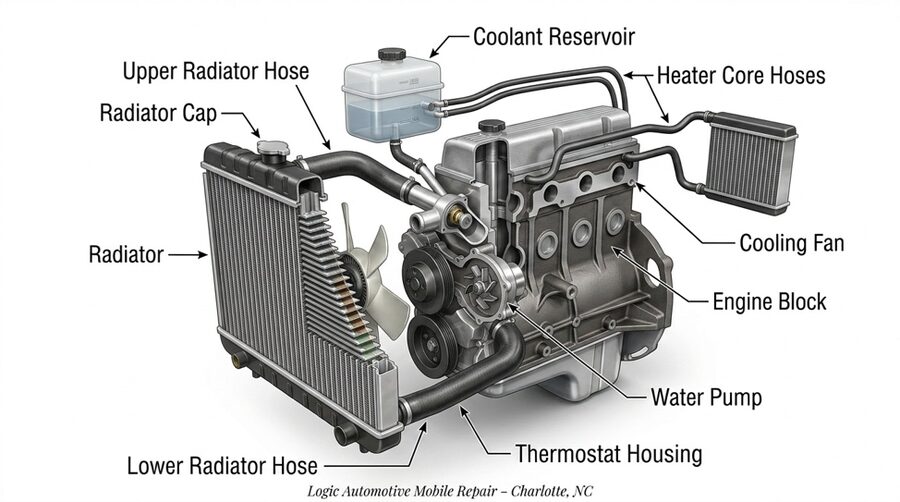
How Your Radiator and Cooling Fans Work
The radiator sits at the front of the vehicle so air flowing through the grille can help cool the coolant, especially at highway speeds. It has large rubber coolant hoses connected to it and should not be confused with the A/C condenser, which is a separate component usually mounted in front of the radiator. When the vehicle is not moving fast enough for good airflow, the cooling fans pull air through the radiator.
There are two common types of fans. Many modern cars use electric fans controlled by the computer. Some older vehicles and trucks use engine-driven fans, often attached through a fan clutch and powered by the engine belt system. At highway speed, airflow through the radiator usually does most of the cooling — so if a car overheats more on the highway than at idle, the problem is often something other than just the fan.
The Water Pump and Thermostat
Coolant flows through the engine and absorbs heat. The water pump moves that coolant through the system and is usually driven by the serpentine belt or timing belt, depending on the engine design — on some vehicles it is driven by the timing chain. The coolant travels through passages in the block and cylinder head, removing heat from combustion.
The thermostat controls when coolant is allowed to flow through the radiator. When the engine is cold, the thermostat stays closed so the engine warms up faster. Once it reaches operating temperature, the thermostat opens and lets coolant circulate through the radiator. If the thermostat gets stuck closed, coolant cannot circulate properly and the engine can overheat quickly.
Sensors, Hoses, Pressure, and the Coolant Reservoir
The engine has a coolant temperature sensor that sends temperature data to the computer and gauge. If the engine gets too hot, that sensor helps trigger warnings and may command the electric fans on. The heater core is another cooling-system part, located inside the dash, where coolant flows to provide cabin heat — two heater hoses usually run from the engine to the firewall and back. That is why running the heater can pull a little extra heat out of an overheating engine in a pinch.
Many vehicles use an expansion tank (coolant reservoir) that lets coolant expand and contract as the engine heats and cools. If your vehicle has a radiator cap directly on the radiator, that cap is very important because it maintains system pressure — and pressure raises the boiling point of the coolant, which helps prevent boil-over and overheating. A worn or weak radiator cap that no longer holds pressure can let coolant boil sooner than it should.
Common Overheating Causes on the Highway
Some of the most common causes of overheating on the highway include:
- Low coolant (often from a leak)
- A stuck thermostat
- A weak water pump
- A clogged radiator
- A collapsed radiator hose
- Air pockets trapped in the cooling system after a coolant change
- Combustion gases entering the cooling system from a bad head gasket
A bad cooling fan can cause overheating too, but that problem is usually more noticeable in traffic or at idle than at highway speed, where airflow does most of the cooling.
Why It Overheats More at Highway Speed Than Sitting Still
Pay attention to when the temperature climbs — it is one of the most useful clues you can give a mechanic.
If the vehicle overheats more at highway speed than it does sitting still, the fan is usually not your problem, because at speed the air is already rushing through the radiator. Highway overheating more often points to:
- Low coolant
- Restricted or clogged radiator flow
- A thermostat that is stuck or not opening fully
- A weak water pump that cannot keep up with demand at higher RPM
- A collapsed radiator hose that restricts flow under suction
- Air pockets in the system
- Combustion gases from a head gasket issue pressurizing the cooling system
If instead it overheats more at idle or in stop-and-go traffic and cools down once you get moving, that points more toward a fan problem — a failed electric fan, a bad fan relay, or a worn fan clutch — because at low speed the fan is doing most of the work.
How to Check for Leaks Safely and Spot Water Pump Issues
Before any check: make sure the engine is fully cool and off, and never open a pressurized cooling system while it is hot. Keep your hands, tools, and clothing away from belts and the cooling fan, which can switch on by itself even with the key off on some vehicles.
If your coolant level is consistently low, there is a very high chance you have a leak somewhere. You can look up a coolant routing diagram for your specific make and model to trace where it might be coming from, but the fastest and most accurate way to find a hidden leak is a cooling system pressure test — something a mobile mechanic can perform on-site as part of cooling system diagnostics.
Diagnosing a failing water pump is trickier. One simple test is to carefully feel the upper and lower radiator hoses after the engine has been running and then cooled enough to touch. If the top hose is very hot but the bottom hose stays cold, you likely have a flow issue. An old-school trick is to use a long pry bar or screwdriver like a stethoscope: with the engine off and cool, place the metal tip against the water pump housing and press your ear to the handle, then have a helper start it briefly. A rough, grinding, or growling noise means the internal bearings are likely failing.
Be extremely careful to keep the tool, your hands, and your clothing far away from moving belts and the cooling fan whenever the engine is running.
Thermostat and Radiator Warning Signs
You can test for a bad thermostat using a similar hose method. Start the car cold and let it idle for about 10 to 15 minutes. Once the engine reaches operating temperature, the thermostat should open and you should feel the upper radiator hose suddenly get hot and firm as coolant starts flowing. If the hose stays cold while your dashboard temperature gauge climbs higher and higher, that strongly indicates a thermostat stuck closed.
Finally, inspect your radiator. Visually check whether the front is clogged with leaves, dirt, or debris. You can also check for uneven heating once the engine is warm — if the radiator is hot in some areas but completely cold in others, it is likely clogged internally and not flowing the way it should.
When Not to Keep Driving
Some warning signs mean you should stop driving and shut the engine down right away, even if you are close to home:
- The temperature gauge is pinned in the red or a hot-engine warning light is on.
- Steam or coolant smell is coming from under the hood.
- You see coolant dripping or spraying.
- The engine is losing power, knocking, or running rough while hot.
- White, sweet-smelling smoke is coming from the exhaust (a possible head gasket sign).
Pushing a hot engine even a few more miles is how a cheap thermostat or hose turns into a blown head gasket or a destroyed engine. If you are not sure, park it and call for help. Not sure if it is a cooling issue or something else like a fuel delivery problem? We can diagnose it on-site.
Call a Mobile Mechanic in Charlotte
Cooling systems can be complex, and guessing wrong can cost you an engine. When in doubt, the smartest move is to stay parked and call a local mobile mechanic. As a mobile mechanic in Charlotte, we come directly to your location across Charlotte and 15 nearby cities, run a proper pressure test, accurately diagnose the problem, and fix it on the spot without the risk of further engine damage. Heading out on a road trip? It is also worth a pre-trip inspection or, if you are buying a used car, a used car red flag check before you rely on it in summer heat.