In this guide
- Signs Your Fuel System May Be Failing
- How the Fuel System Works, From Tank to Engine
- Step 1: Is It Fuel or Something Else?
- Step 2: Check If the Fuel Pump Is Running
- Step 3: Basic Checks When the Pump Doesn't Run
- Step 4: Fuel Pressure Testing on a Running Engine
- Step 5: Key-On and Running Pressure Tests
- Step 6: Checking the Fuel Pressure Regulator
- When to Bring in a Mobile Mechanic
Signs Your Fuel System May Be Failing
If your truck or car takes longer than normal to start, runs rough, or cranks without starting at all, the problem could be in the fuel system. These three symptoms — long crank, rough running, and a no-start — are the most common early warnings that fuel delivery is not what it should be.
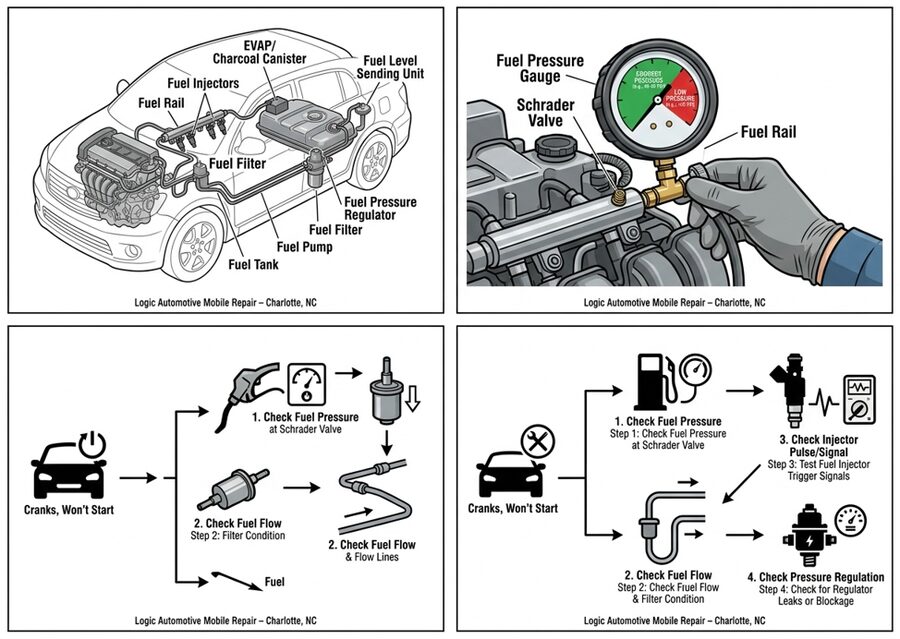
How the Fuel System Works, From Tank to Engine
The fuel system is made up of several components, and it starts at the fuel tank. Whenever you add gas, fuel travels through the filler neck into the tank. Inside or attached to the tank is usually the fuel pump assembly, which may also include the fuel level sending unit and, on some vehicles, the fuel pressure regulator or filter. The tank also has vapor lines that are part of the EVAP system.
The fuel level sending unit
Inside the tank there is a float connected to the fuel level sending unit. This float moves up and down with the fuel level and sends information to the fuel gauge so you know how full the tank is.
The fuel pump and filter
The fuel pump is usually electric on modern vehicles, and its job is to push fuel from the tank to the engine through the fuel lines. Before reaching the engine, fuel may pass through a fuel filter that keeps dirt and debris away from the injectors. On some vehicles the filter is serviceable; on others it is built into the pump assembly. A clogged serviceable filter can restrict flow and cause drivability problems.
The fuel rail and injectors
At the engine, fuel enters the fuel rail, which supplies the injectors. The injectors spray fuel into the intake ports or directly into the combustion chamber. Fuel pressure must stay within a specific manufacturer range for the engine to run properly.
What controls fuel pressure
Fuel pressure is controlled either by a fuel pressure regulator or by the fuel pump control system, depending on the vehicle. If pressure is too low or too high, the engine may crank for a long time, run rough, hesitate, or fail to start.
The EVAP system
The fuel vapor line runs to the EVAP system, which includes the charcoal canister (sometimes called the vapor canister). This system stores fuel vapors and helps keep them from escaping into the atmosphere; later those vapors are routed back into the engine and burned during normal operation.
Step 1: Is It Fuel or Something Else?
If the engine cranks but will not start and you want to quickly rule out a fuel issue, perform a simple test:
- Remove the air intake tube so you can access the throttle body.
- Hold the throttle plate open.
- Spray a small amount of starting fluid into the throttle body.
- Reinstall or hold the intake tube so the engine is not sucking in unfiltered air.
- Try to start the engine.
If the engine does not even try to fire with starting fluid, the problem is likely not fuel-related — move on to checking spark, compression, or timing. If the engine starts briefly or tries to fire and then dies, that strongly suggests a fuel delivery problem.
Safety note: Use starting fluid made for engines — not brake cleaner. Brake cleaner is harsh, not designed to be burned, and can be unsafe to inhale.
Step 2: Check If the Fuel Pump Is Running
If the starting-fluid test points to a fuel problem, the next step is to see whether the pump is coming on:
- Turn the key to the ON position (or have a helper do it) while you listen near the fuel tank.
- On many vehicles you will hear a short buzzing or humming sound for a few seconds as the pump primes, then it shuts off.
- If you cannot hear it from outside, place the tip of a long screwdriver or pry bar against the fuel tank and put your ear to the handle while a helper cycles the key — it acts like a stethoscope.
If the pump runs constantly and never shuts off, you may have an electrical issue such as a stuck relay, a wiring problem, or a control module fault. If the pump never turns on at all, check the basics before condemning the pump.
Step 3: Basic Checks When the Pump Doesn't Run
If the pump is not coming on:
- Gently tap the bottom of the fuel tank with a rubber mallet or dead-blow hammer while a helper turns the key. A failing pump that temporarily wakes up when tapped is a strong sign the pump is bad.
- Check the fuses and relays related to the fuel pump circuit.
- Inspect visible wiring and connectors at the tank for damage, corrosion, or loose connections.
- Use a test light or multimeter to verify power and ground are reaching the fuel pump connector when the key is on or while cranking.
If you have good power and ground at the connector and the pump still does not run, the pump assembly is very likely bad and should be replaced.
Step 4: Fuel Pressure Testing on a Running Engine
If the engine runs but is misfiring, stumbling, or feels fuel-starved, a fuel pressure test is one of the best ways to confirm a fuel problem.
- Locate the Schrader valve (test port). On many vehicles this is on the fuel rail; on others it may be on a fuel line, often under a plastic cap.
- With the engine off, thread the correct adapter from your fuel pressure test kit onto the Schrader valve and tighten it so it seals.
- Attach the fuel pressure gauge to the adapter.
Step 5: Key-On and Running Pressure Tests
Key-on / prime test
Turn the key to ON (without starting) and watch the gauge. Pressure should rise quickly, then drop slightly and hold. If pressure builds and then drops rapidly to zero, check for leaks at your fittings first. If the fittings are dry and tight, a rapid drop may indicate a leaking fuel pressure regulator returning fuel to the tank, a bad check valve inside the pump, or a leaking injector. You can sometimes confirm a leaking injector by removing the spark plugs and checking for raw fuel or a strong gas smell in one cylinder.
Running pressure test
Look up the correct fuel pressure spec for your vehicle at idle and under load. Start the engine and watch the gauge — pressure should be steady and close to factory spec. Lightly rev the engine and watch how it responds. If pressure is consistently below spec and the engine struggles, the most likely causes are a weak fuel pump or a restricted filter. If pressure is higher than it should be, the regulator may not be controlling pressure properly. If pressure slowly bleeds down after shutdown and you also have long crank times, suspect a leaking regulator, a failing pump check valve, or a leaking injector.
Step 6: Checking the Fuel Pressure Regulator
If you suspect the regulator, visually inspect it and the surrounding area for fuel leakage or a strong fuel smell. If your regulator has a vacuum line, carefully disconnect the vacuum hose — if there is fuel inside the hose or it smells strongly of raw fuel, the diaphragm is likely ruptured and the regulator should be replaced.
When to Bring in a Mobile Mechanic
Fuel system diagnosis can involve high-pressure fuel, electrical testing, and working around flammable vapors. If at any point you are unsure, do not guess — a wrong move can damage components or create a fire hazard. A mobile mechanic can perform safe fuel pressure tests with the correct adapters, check power and ground at the pump, verify regulator operation, and confirm whether the problem is the pump, filter, injectors, or something else entirely. We bring the test kit and adapters to you across Charlotte and 15 nearby cities — see our mobile diagnostics or call to book. Dealing with a summer breakdown instead? See our guide on overheating on I-77.