In this guide
How Your Suspension Actually Works
Your suspension system helps keep the tires planted on the road, helps control the vehicle during braking and turning, and makes the ride more comfortable. When the car goes over a bump, the spring compresses and stores energy, then the shock absorber or strut dampens that spring movement so the car does not keep bouncing. That is how the suspension keeps the tires in contact with the road instead of losing control over rough surfaces.
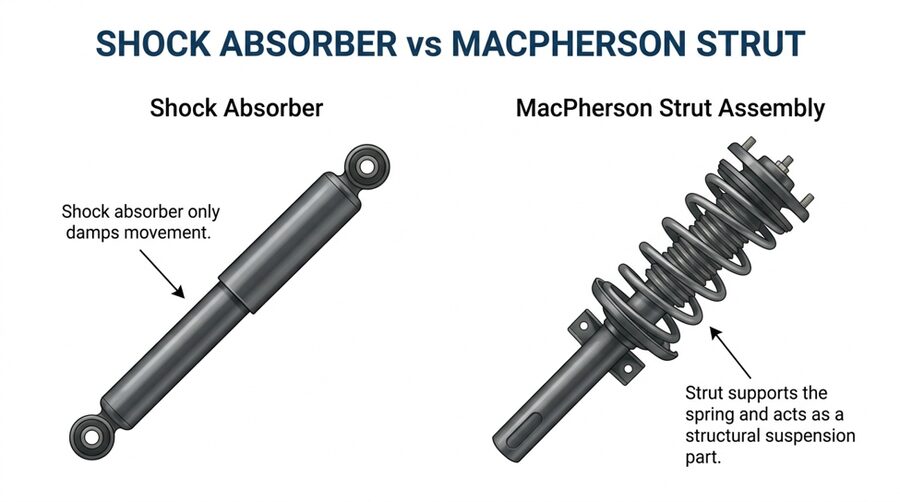
The spring and the strut are not the same part. The spring supports the weight of the vehicle, while the shock absorber or strut controls how fast that spring compresses and rebounds. A strut also acts as a structural part of the suspension on many vehicles, which is why worn struts can affect both ride quality and handling.
Suspension Spring Types
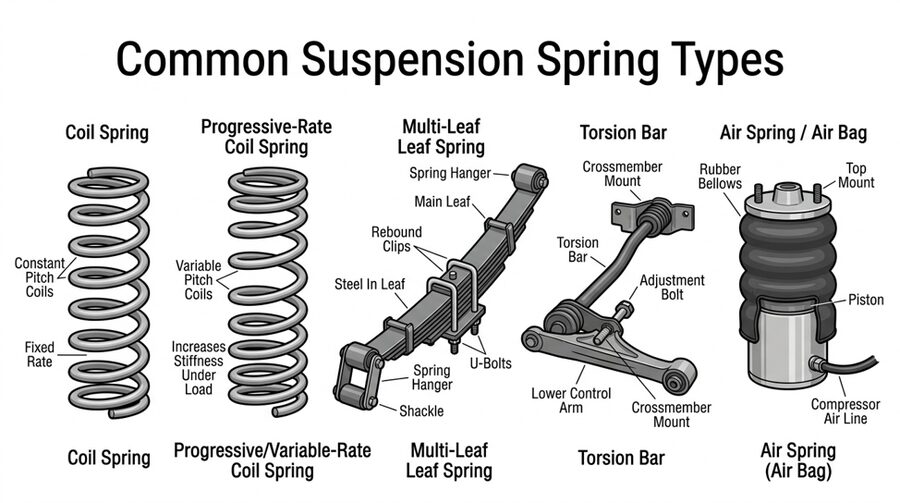
There are several types of springs used in suspension systems, and each one has a different purpose.
Linear springs
Linear springs have a steady spring rate — each inch of compression takes about the same increase in force. They feel predictable and consistent through their movement.
Variable-rate (progressive) springs
Variable-rate springs, also called progressive springs, do not stay the same through the whole travel. They may feel softer at first, then get stiffer as they compress more. That helps balance comfort with load support, body control, and resistance to bottoming out.
Leaf springs
Leaf springs are usually found on trucks and heavier vehicles. They use multiple steel leaves stacked together and mounted lengthwise. As the suspension moves, the leaf spring flexes to carry load and absorb movement. Many setups use a shackle on one end so the spring can change effective length slightly as it flexes.
Torsion bars
A torsion bar is also a spring, but instead of compressing like a coil spring, it twists. One end is fixed to the frame or subframe and the other connects to a control arm. As the suspension moves, the bar twists and then wants to return to its original position — which is what gives it its spring effect.
Air suspension
Air suspension uses flexible rubber air springs filled with compressed air instead of steel springs. A compressor and control system adjust the air pressure to control ride height and support load. When air suspension has a problem, common signs include sagging, one corner sitting low, hissing, or a compressor that runs too often.
Shocks and Struts
Shock absorbers and struts dampen spring movement. Without them, the spring would keep oscillating and the vehicle would keep bouncing after every bump.
A shock absorber mainly controls motion. A strut controls motion too, but it also supports the suspension structurally on many vehicles. In a MacPherson strut setup, the strut often supports the spring and helps maintain suspension geometry — which is why strut problems can cause both noise and poor steering feel.
Why Control Arms Are So Important
Control arms are one of the most important suspension parts because they keep the wheel moving only in the path it is supposed to move. Their job is not just to connect parts together — they control wheel position.
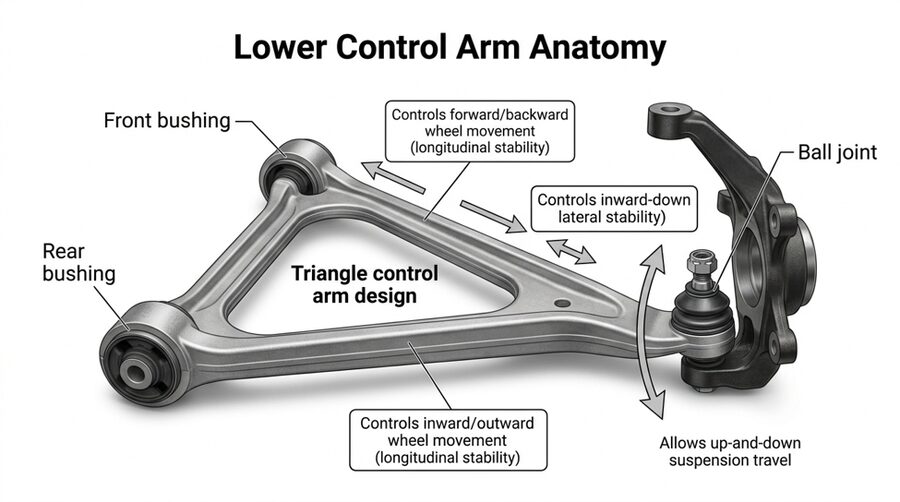
On many vehicles, especially in the front suspension, the lower control arm is shaped like a triangle. A lot of them have two inner mounting points where they bolt to the frame or subframe through bushings, and one outer point where they connect to the steering knuckle through a ball joint. That triangular shape gives the arm strength and helps control the wheel in more than one direction at the same time.
The control arm keeps the tire from moving too far forward or backward, and also controls inward and outward movement while still allowing the suspension to move up and down. That is why worn control arm bushings can cause so many different symptoms. If the bushings tear or soften, the control arm can move more than it should — leading to clunking, pulling while braking (which can feel like a brake problem but is actually suspension), wandering steering, uneven tire wear, and a loose feeling in the front end. If you suspect worn control arm bushings or ball joints, our on-site suspension diagnostics can confirm it before it gets worse.
Ball Joints and the Steering Knuckle
Ball joints connect the control arm to the steering knuckle. They allow the suspension to move up and down while also letting the steering knuckle pivot when you turn the wheel.
The steering knuckle is the part the wheel hub bolts to, and it ties several important parts together. It works with the ball joints, control arms, and tie rod so the wheel can move with the suspension and still turn left and right. When a ball joint wears out, it can create clunking, looseness, and poor steering response.
How Sway Bars and End Links Work
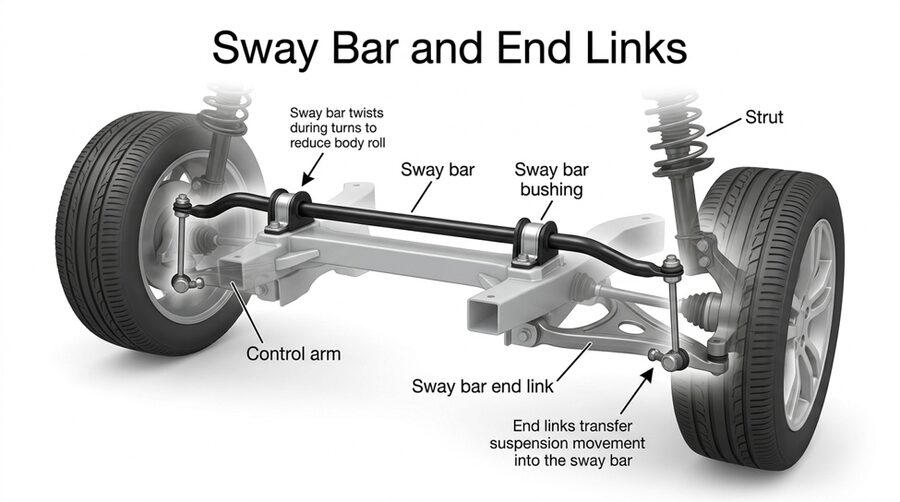
The sway bar, also called the stabilizer bar, reduces body roll when the vehicle turns. When the car leans to one side in a corner, the sway bar twists and resists some of that lean, helping the car feel flatter and more stable.
The sway bar is usually mounted to the frame with bushings and connected to the suspension by sway bar end links. Depending on the design, the end links connect the bar to the control arm or the strut. Their job is to transfer suspension movement into the sway bar so it can actually work.
That makes sway bar end links more important than many people realize. If an end link is loose, worn, or broken, the sway bar cannot do its job as well. This can cause clunking or rattling over bumps and make the car feel less stable when cornering. Worn sway bar bushings can also cause squeaks, pops, or knocking noises as the bar shifts during suspension movement.
Quick Recap
Your suspension keeps the tires planted, controls the vehicle, and smooths the ride. The spring stores energy; the shock or strut dampens it. Control arms keep the wheel on its correct path — worn bushings or ball joints let it shift and cause clunking, pulling, and uneven tire wear. The sway bar and end links control body roll in turns; worn links and bushings cause rattles and squeaks. If a noise is getting worse or the car feels loose or unstable, have it inspected before it turns into a bigger repair. We offer on-site suspension and brake diagnostics as a mobile mechanic in Charlotte.